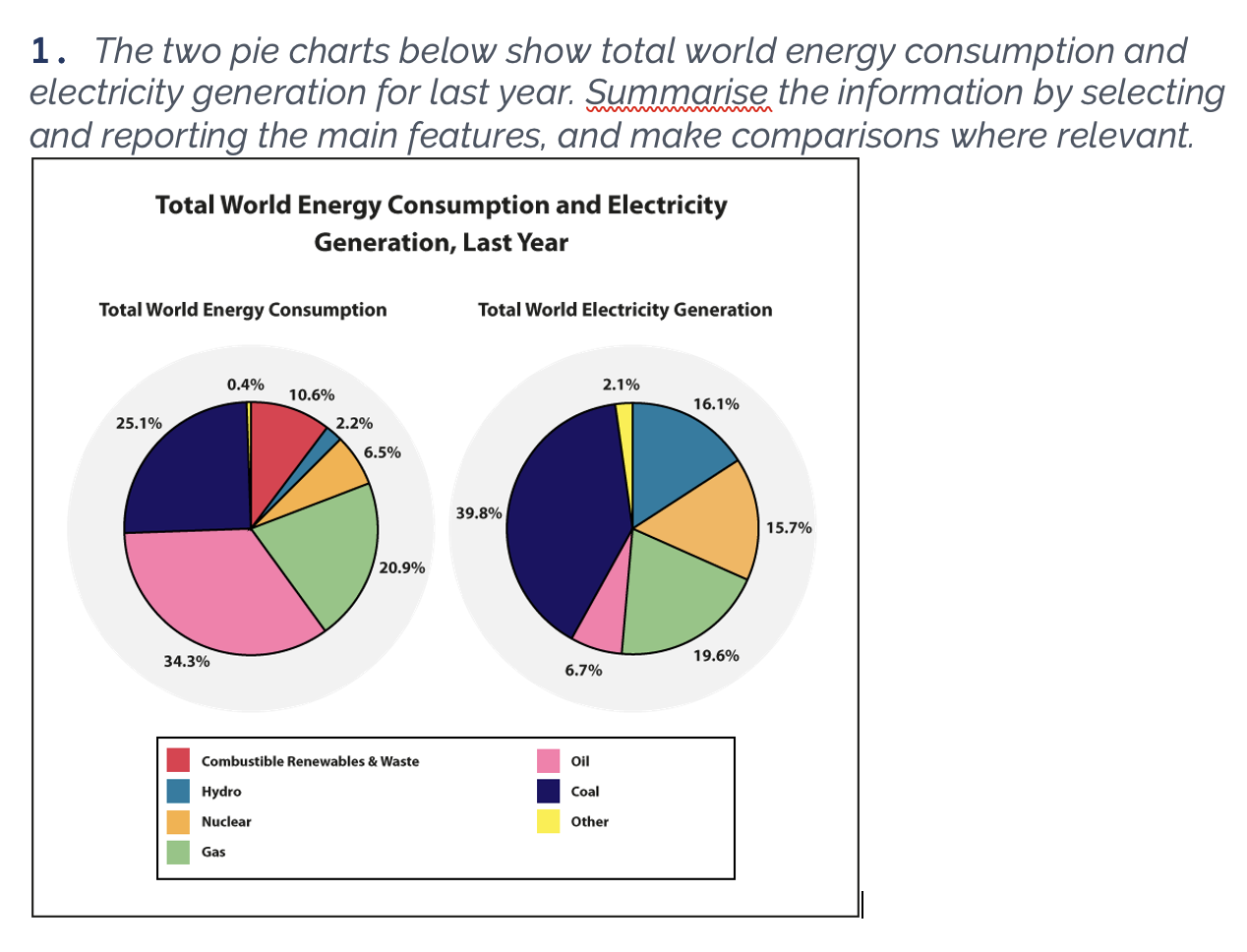
The provided pie charts compare the proportion of energy consumed and electricity generated by different energy sources worldwide for the previous year.
What is most striking when looking at the pie charts is that fossil fuels, which encompass oil, coal, and gas, made up the majority of both energy use and supply of electricity. By contrast, renewable and clean energy accounted for a significantly smaller proportion of the total. Moreover, oil required the largest share of global energy while providing the smallest share of power.
As for conventional fossil fuels, it can be seen that oil constituted roughly a third of energy demand worldwide, which was followed by coal accounting for approximately a fourth of the total. However, while coal provided almost 40% of global electricity, oil's production of electricity was insignificant, being less than 7%. Gas, on the other hand, constituted roughly 20% of both energy use and power generation.
A stark difference is evident in the case of clean and renewable forms of energy, which collectively formed a much smaller share in overall energy use and electricity provision. The electricity production from all resources of clean and renewable energy was more than their energy consumption, with the exception of combustible renewables and wastes, which consumed 10% of global energy while supplying no electricity. Nuclear power consumed roughly 6% of total energy, triple that of hydro, whereas both forms of energy supplied around 15% of total world electricity.
What is most striking when looking at the pie charts is that fossil fuels, which encompass oil, coal, and gas, made up the majority of both energy use and supply of electricity. By contrast, renewable and clean energy accounted for a significantly smaller proportion of the total. Moreover, oil required the largest share of global energy while providing the smallest share of power.
As for conventional fossil fuels, it can be seen that oil constituted roughly a third of energy demand worldwide, which was followed by coal accounting for approximately a fourth of the total. However, while coal provided almost 40% of global electricity, oil's production of electricity was insignificant, being less than 7%. Gas, on the other hand, constituted roughly 20% of both energy use and power generation.
A stark difference is evident in the case of clean and renewable forms of energy, which collectively formed a much smaller share in overall energy use and electricity provision. The electricity production from all resources of clean and renewable energy was more than their energy consumption, with the exception of combustible renewables and wastes, which consumed 10% of global energy while supplying no electricity. Nuclear power consumed roughly 6% of total energy, triple that of hydro, whereas both forms of energy supplied around 15% of total world electricity.
Piecharts.png
