FCQ3-2025-T1
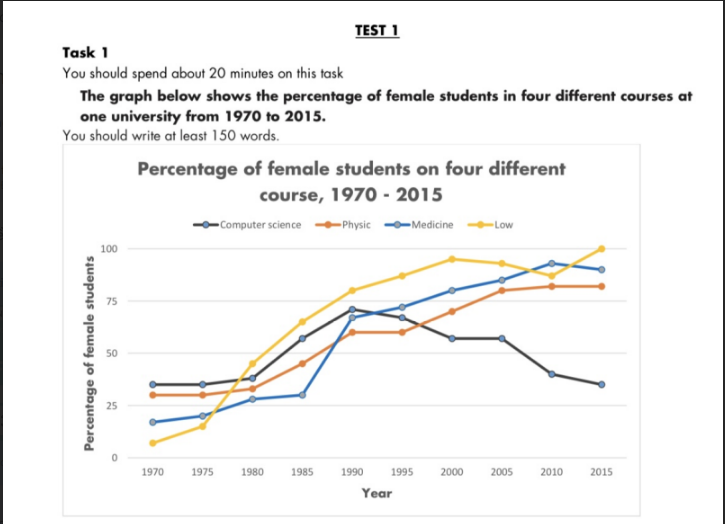
The line graph illustrates the proportion of female learners enrolled in four distinct courses at a university between 1970 and 2015. Overall, the percentage of female students increased in all subjects except Computer Science, which fluctuated and eventually declined. Law consistently attracted the highest percentage of female scholars, while Computer Science ended with the lowest share.
In 1970, the number of female students registered in law courses was the smallest at nearly one-tenth; however, after 3 decades, it rose significantly to about 90%. Before reaching its peak of 100%, female students attending this course decreased slightly to around 85%. From 1985 to 1990, the number of female learners studying medicine surged dramatically by about 40%, and then climbed until 2010, before dropping marginally to approximately 87%. The Physics course remained stable in the first decade in the share of female students. Nevertheless, the figure increased substantially to nearly 60%, then remained unchanged for the next five years, and recorded a rise to almost 80% at the end of the period.
Regarding the most fluctuated category, with the highest start at roughly 35%, the proportion of female scholars attending computer science increased slightly to about 38% in the first 10 years, before climbing remarkably to around 70%. Nonetheless, there was a decrease relative to its initial point by 2015.
Appreciate it!
Mr Calma
The line graph illustrates the proportion of female learners enrolled in four distinct courses at a university between 1970 and 2015. Overall, the percentage of female students increased in all subjects except Computer Science, which fluctuated and eventually declined. Law consistently attracted the highest percentage of female scholars, while Computer Science ended with the lowest share.
In 1970, the number of female students registered in law courses was the smallest at nearly one-tenth; however, after 3 decades, it rose significantly to about 90%. Before reaching its peak of 100%, female students attending this course decreased slightly to around 85%. From 1985 to 1990, the number of female learners studying medicine surged dramatically by about 40%, and then climbed until 2010, before dropping marginally to approximately 87%. The Physics course remained stable in the first decade in the share of female students. Nevertheless, the figure increased substantially to nearly 60%, then remained unchanged for the next five years, and recorded a rise to almost 80% at the end of the period.
Regarding the most fluctuated category, with the highest start at roughly 35%, the proportion of female scholars attending computer science increased slightly to about 38% in the first 10 years, before climbing remarkably to around 70%. Nonetheless, there was a decrease relative to its initial point by 2015.
Appreciate it!
Mr Calma
Capture.PNG
